Spring Thoughts
Now, in March, we are all longing for spring. Even I find myself humming spring songs—birds are chirping and twittering, and we’re told to take joy from their supposed merriment.
Merriment? We know that birds don’t sing because they’re happy; they sing to court mates and claim territory. The 18th and 19th centuries romanticised and anthropomorphised this, giving rise to those (actually rather silly) lyrics that express our human longings.
Humans are naturally curious, and not always driven by the desire to have. Often, it’s the desire to know—the urge to look beyond the obvious. But all too often, it’s greed and the conviction that we are the crown of creation, entitled to own everything. We claim rights that aren’t ours, harming not only this planet—a priceless gift—but also ourselves.
This is reflected in the question: Are animals intelligent?
The question itself is foolish. Of course animals are intelligent—whether individually or as part of a swarm. They simply aren’t intelligent in the human way; they have their own intelligence. In our arrogance, we reduce animal behaviour to instinct, overlooking the fact that instinct alone isn’t enough to ensure the survival of an individual or a species. But animals do plan. Not just primates, dolphins, and elephants—all animals. Maybe not for weeks, months, or years, but for the immediate time needed to accomplish something.
Recognising this doesn’t require science—just observation. Ethology takes a far more intelligent approach than conventional science (which, to me, is more like guesswork). How can we measure intelligence by making an animal count or mimic human sounds? That has nothing to do with intelligence. How can we recognise intelligence when we don’t even have a universally accepted definition of it?
To me, intelligence isn’t a single, general thing. There’s practical intelligence, theoretical intelligence, and social intelligence. Some people have incredibly skilled hands and a deep understanding of how things work. Others excel at learning and storing vast amounts of knowledge. And then there are those who connect with others, who have profound empathy and make wonderful companions.
If we apply this understanding to animals, what stands out among our cousins—and yes, all animals are our cousins, not just primates—is their practical and social intelligence. Reels on Facebook show a gorilla rescuing a lion cub from water, and people are astonished. They’re stunned by friendships between supposed natural enemies in the animal kingdom and moved to tears when they see an animal grieving a lost companion.
But I wonder: how can humans be so surprised by these examples? We’re capable of all this, yet we’re nothing more than the animal with the most developed brain—one we clearly don’t use much in daily life, otherwise we wouldn’t keep sawing off the branch we’re sitting on. A one-month-old human embryo is indistinguishable from a chick embryo, a tadpole, or any other.
What gives us the right to look down on animals and treat them as objects? Is it the biblical command: "Be fruitful and multiply, and subdue the earth"? Or is it the fact that we sit at the top of the food chain? That we’ve built an entirely artificial environment just so that Homo sapiens—the naked ape—can survive?
The truth is, we’ve lost respect. Respect for our own kind, respect for our environment. Without respect, we lose our connection to the world—to our fellow humans, our fellow creatures, and the planet itself. We no longer feel that the whole world breathes, that we’re all made of the same building blocks, that we’re nothing more than tiny particles of the universe. We fear life, we fear loss, we fear death—yet death is nothing but a return to what we originally were: universal energy.
Without respect, we tend toward abuse—even within our own species, race, or family. And so we also abuse our fellow creatures, plants, all of nature, and even what we create ourselves.
"Man is wolf to man."
This observation comes from Plautus, a Roman playwright of the 2nd century BCE, in his work Asinaria (The Comedy of Asses). Thomas Hobbes, an English mathematician, political theorist, and philosopher, popularised the phrase in his Leviathan. Both saw humans as selfish, violent beings—not without reason, given the history of humanity and how we treat the world. The positive term "human" all too easily flips into its opposite. That is my sorrow.
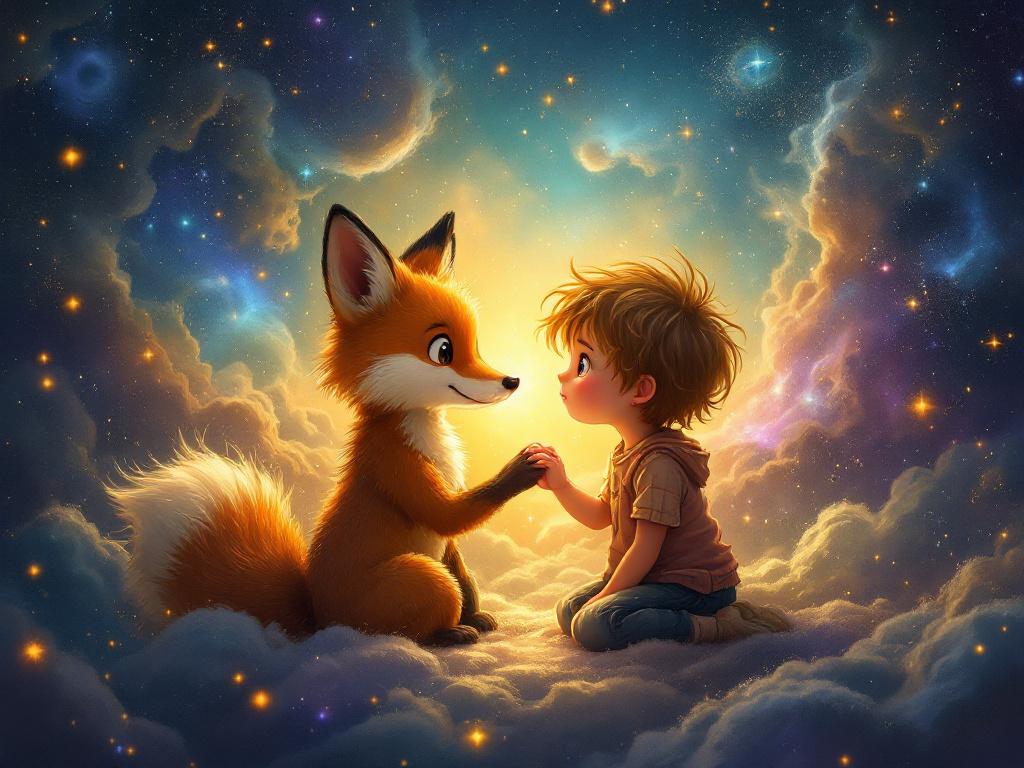
I often think of how openly children embrace the unknown, the new. They approach it without fear and can communicate with animals on a level closed to most adults. I’ve seen this so often in my life, and sometimes I think, as Erich Kästner did: "It’s a pity that children have to grow up."
What do I wish for? That we learn from our animal cousins—unconditional love, trust, respect, and empathy. Above all: respect and attention. They give us all this, and in return, we give them nothing but betrayal, heartlessness, selfishness, baseness, and cruelty. Much of this isn’t even intentional—it’s simply due to a lack of attention, feeling, and understanding.
Let’s be like—no, not like children!—like a dog, who loves and defends its master even when beaten and starved. Only then will we become the humans we’re meant to be.