Little Grey Dust-Thrower
I called him Gucky, because of his enormous eyes, and he arrived on a Holy Saturday. “Take him or I’ll throw him into the Easter bonfire!” said the man who plonked his 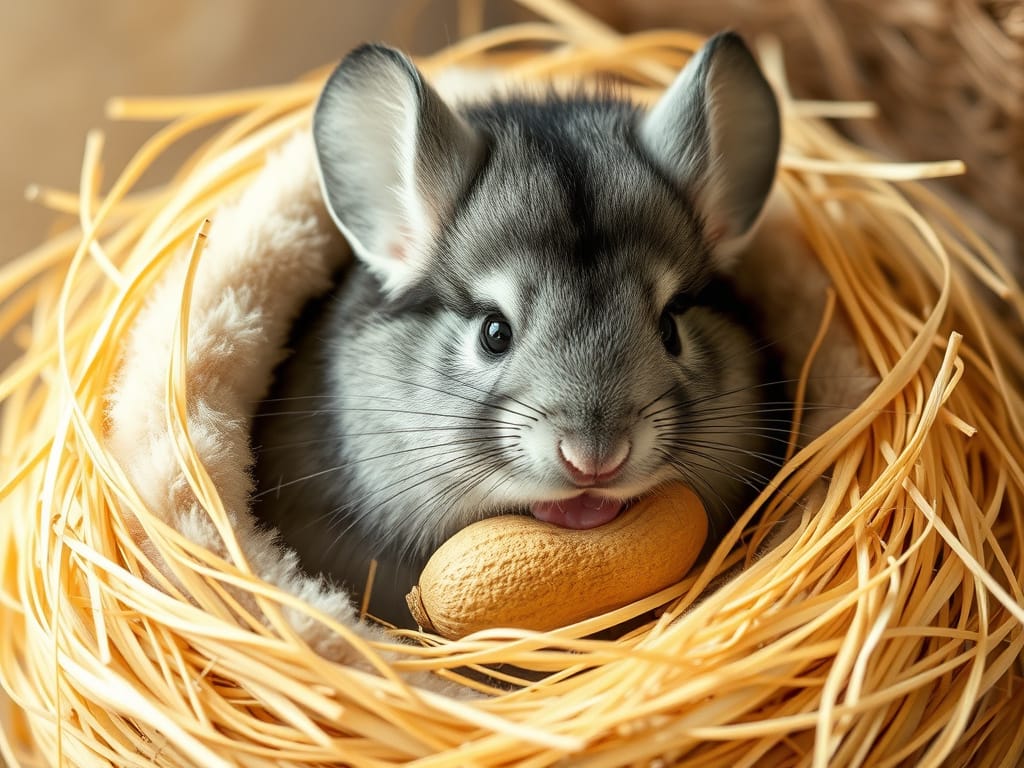 cage on our kitchen table.
Inside that cage sat a large, grey, squirrel-like creature, perched upright with huge, terrified eyes, frozen in fear. And so Gucky came to live with us. We set up a space for him in the kitchen-living room, and then I sat down and spoke softly to him for two hours, gently breathing on him until he finally moved. Cautiously, he came over to me, sniffed my face, and tickled me with his impossibly long whiskers. From that moment on, the chinchilla and I belonged to each other.
Gucky was the last survivor of a failed fur farm. At the time, many people kept pairs of chinchillas, hoping to make money from their pelts. Most of the animals were kept in appalling conditions—often in basements without natural light—and, like Gucky’s companions, most perished miserably. Our little fellow survived; he was three years old when we met. But we faced a question: how do you care for a chinchilla? My first stop was a pet shop, where I learned the basics.
For those who don’t know: Gucky’s diet consisted of pellets—a pressed, nutrient-enriched dry food—fresh root vegetables and fruit, oat flakes, and treats like raisins and nuts, plus, of course, fresh water. He also needed his daily bath—but not in water, in sand! I couldn’t find Chilean sand anywhere, so I got white bird sand and ground pumice, mixed them in a specific ratio, and filled his bath. And then the fun began! First, he’d dig furiously with both paws, then fling himself in and roll around, sending dust flying everywhere. Gucky would stand up, shake himself vigorously—pufffff!—and his Ilse would silently fetch the vacuum cleaner.
During the day, he was left to his own devices, though my mother kept a watchful eye. Mostly, he dozed peacefully. But in the evenings, when I came home from work, he was allowed out to roam freely in my room. He loved using me as a climbing frame. Often, he’d sit on my shoulder and groom himself: his whiskers tickled my left cheek, his bushy tail brushed my right (or vice versa). Though chinchillas are rodents, he barely damaged any furniture. Sometimes he’d escape—he’d quickly learned how to open his cage door. Once, he curled up asleep against the belly of our Airedale Terrier, Lady, who lay perfectly still so as not to wake her “baby”! Another time, he’d chosen the coal box as his resting spot and looked accordingly dusty. A third time, he’d climbed the wooden stairs to my room and didn’t dare come back down. But he was never left unattended for long; my mother was always home and played a regular game of “search and rescue.”
Our Gucky was a gentle soul, but he hated flies. A fat fly buzzed into his cage, and for the first and only time, we saw murderous red rage flash in his usually beautiful eyes. He sat there like a predator, upright as a marmot, paws poised to strike, fury burning in his big eyes. Maybe the fly sensed it—it never came back.
He also despised cheese. At the mere smell, he’d shudder from whisker-tips to tail-tip in disgust. My mother couldn’t understand it—after all, Gucky had been introduced to her as an “Andean mouse,” and mice love cheese, don’t they? Back then, none of us knew much about chinchillas. They were rather exotic housemates.
As I said, Gucky was very gentle and affectionate. But only my mother (and even then, only as a substitute for me) was allowed to touch him; otherwise, he’d shed tufts of fur in protest. Visitors, ignoring my urgent warnings, would stick their fingers into his cage and be quite offended when he bit them. He did like to bite—such intrusive people were not to his taste. He had a good bite, as I discovered the this way (though he never did it to me).
For a long time, I didn’t realise how deeply attached he was to me. Then I had to go on a week-long business trip. I said goodbye properly and left him in my mother’s care. She looked after him devotedly, with great care and, above all, regularity (something I wasn’t always so strict about!). When I returned after five days, Gucky was deeply offended. He wouldn’t speak to me, tucked his head into a corner, and turned his little bottom towards me no matter which way I moved. It took me a good hour of coaxing to win him back!
Tricks only worked on him once; a second time, he wouldn’t be fooled. A trail of raisins to lure him back into his cage worked just once; the next time, he stopped just out of reach and forwent the treats. However, once he knew he had regular outings, he’d soon come of his own accord to take nuts and raisins from my hand.
Gucky lived with me for fifteen years, reaching the age of eighteen. On his last evening, he refused to go back into his house. As I held him in my arms, a terrible certainty overcame me: the time had come. So I made him a soft nest beside me—he took all night to die, and it was agonising. But he wasn’t ill, just old. In the morning, I had to go back to work—I hadn’t slept all night—and my father took it upon himself to prepare Gucky’s final resting place.
Rest in peace, my dear, unforgettable little friend.