Batya Gur
One of my favourite crime novelists is the Israeli writer Batya Gur. Born on 20 January 1947 in Tel Aviv, Gur was a journalist and literary scholar who moved in Jerusalem’s 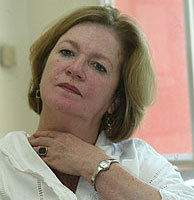 educated circles—the very setting where most (though not all) of her extraordinary novels unfold. She had a rare gift for portraying the psychological depths of her characters, and she did so without ever being dull. Quite the opposite: her books—though calling them mere "crime novels" feels reductive—are gripping and deeply lifelike. The focus is always on the people, not just the puzzle of the crime; her stories are simply different.
On Translation:
Readers familiar with multiple works by Batya Gur may notice variations in the spelling of names. This stems from Hebrew’s script, which—like Arabic—records only consonants, leaving vowels to the reader’s interpretation. Translators, therefore, sometimes render names differently, adding a layer of linguistic nuance to her books.
Sadly, Batya Gur passed away on 19 May 2005 in Jerusalem—a loss I still feel deeply. The photograph of her on this page was taken by Casaresricardo in 2003.
And now her books:
Batya Gur’s Michael Ohayon Series – English Translations
The Saturday Morning Murder (1992)
Michael Ohayon’s debut case: A murder in a quiet Jerusalem neighborhood on a Saturday morning. Ohayon, a thoughtful and intuitive detective, navigates the complexities of Jerusalem’s diverse society to uncover the truth. This novel won the German Crime Fiction Award.
Literary Murder: A Critical Case (1993)
When a literary critic is found dead, Ohayon delves into the cutthroat world of academia and literature. The case challenges his understanding of human nature and the power of words.
Murder on a Kibbutz (1994)
Ohayon investigates a murder within the seemingly idyllic, but tightly knit and secretive, world of a kibbutz. The case exposes the tensions and hidden conflicts beneath the communal surface.
Murder Duet (1999)
A musician’s death leads Ohayon into the competitive and passionate world of classical music. The mystery tests his ability to reconcile artistry with crime.
Bethlehem Road Murder (2004)
Set against the backdrop of Jerusalem’s political and social divides, Ohayon faces a case that blurs the lines between personal and political motives, taking him close to the city’s contested borders.
Beyond the Ohayon Series: Batya Gur’s Hidden Gems
While only Batya Gur’s Michael Ohayon mysteries are available in English, her other novels—equally rich in psychological depth and social insight—are true treasures for those who read German or Hebrew. Here are a few standout titles worth seeking out:
"In the Beginning" (Am Anfang war das Wort) – A profound exploration of faith, language, and human connection, set against the backdrop of Jerusalem’s intellectual circles.
"Thou Shalt Not Covet" (Du sollst nicht begehren) – A gripping tale of desire, morality, and the complexities of modern relationships.
"Living in Jerusalem" (In Jerusalem leben) – Not a crime novel, but a vivid, almost poetic portrait of daily life in Jerusalem, capturing the city’s contradictions and its people’s resilience.
These works showcase Gur’s unparalleled ability to weave social commentary into compelling narratives. If you’re lucky enough to read German or Hebrew, don’t miss them—they’re every bit as rewarding as her Ohayon mysteries.
For English readers: Let’s hope more of her books find their way into translation soon!
For me, Batya Gur remains the most unflinching and vibrant "painter" of Israeli life, capturing the incredible diversity of thought in such a complex society.
My recommendation? Absolutely essential reading.