J.R.R. Tolkien
(born 1892,
 died 1973)
Tolkien was not, first and foremost, a writer; he was a linguist—a scholar of language—and taught as a professor at a British university. His 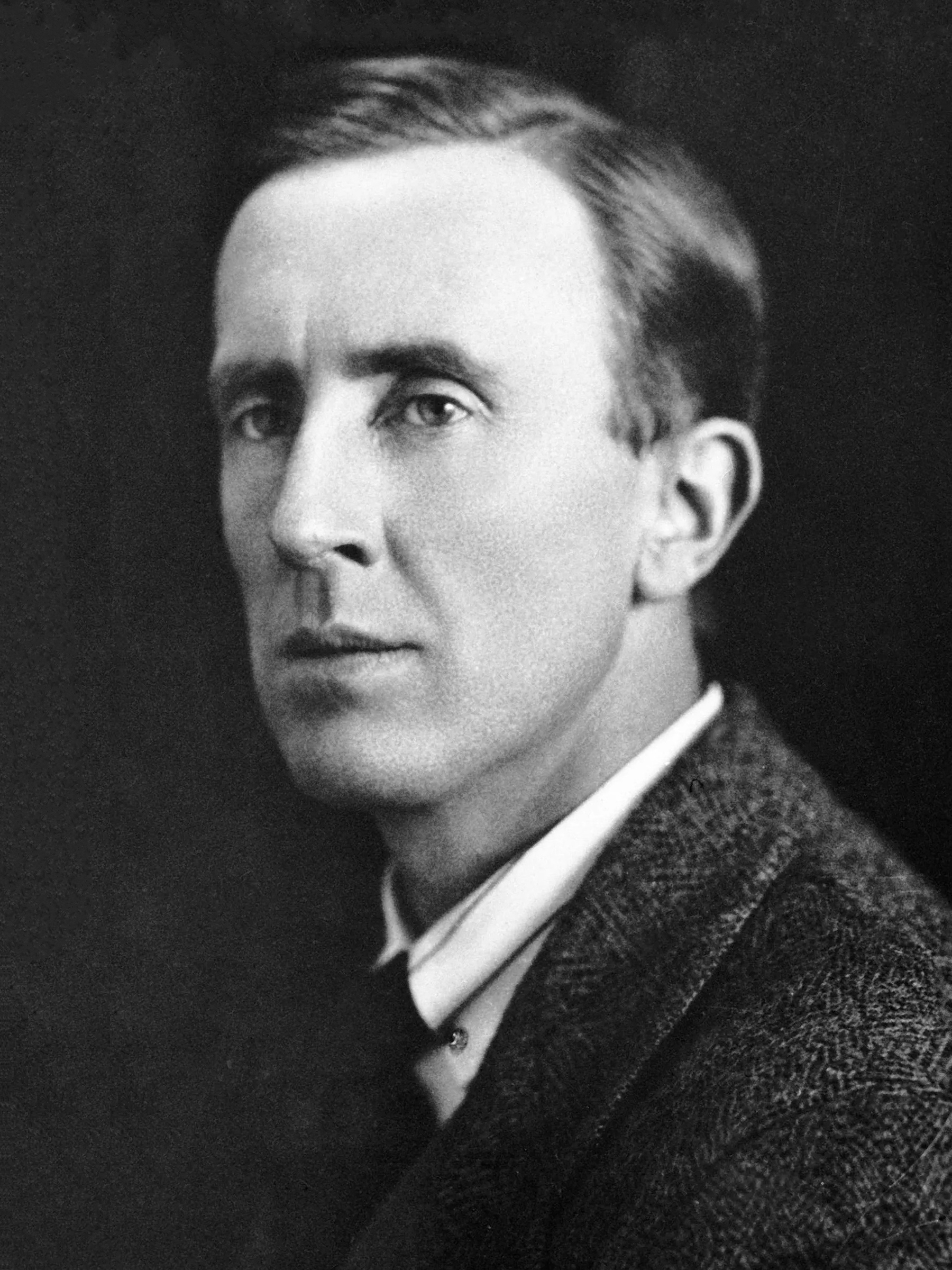 passion for languages and his joy in inventing them for sheer pleasure led him, over decades, to imagine an entire, intricate world complete with its own mythology, writing systems, and tongues. He wrote it all down, and thus were born tales like The Silmarillion and The Lord of the Rings. Yet he began with small, whimsical, and playful stories for his children, honing his craft as a storyteller.
The conversation excerpted here references the sagas and legends of Middle-earth as told in The Silmarillion. Indeed, The Lord of the Rings is nothing less than a grand novel built upon mythological foundations, the logical continuation of The Hobbit—a story that started as a children’s tale.
The Lord of the Rings followed a similar path: what began as a simple narrative grew almost of its own accord into a vast epic, one that had been germinating in Tolkien’s mind for some thirty years. He could never have imagined, as he wrote, the extraordinary success the book would ultimately achieve. Tolkien’s world has since become a cultural phenomenon. Peter Jackson’s films brought it to an even wider audience, though after the first installment, they diverged significantly from Tolkien’s vision. Those seeking the true story of the great War of the Ring will find it only in the books. They alone tell, with unparalleled richness, the tale of a world in transformation. Wolfgang Krege’s translation to German—free of literary embellishment, yet rendered in the language of our time—makes the work an immensely gripping reading experience for German readers.
The photograph was taken by unknown university students in 1925 or 1926.
Core Works About the Ring and Middle-earth
The Hobbit 1937 - Originally a children’s book; introduces Bilbo Baggins, the Ring, and Middle-earth.
The Lord of the Rings 1954–1955 - The three-volume epic (The Fellowship of the Ring, The Two Towers, The Return of the King).
The Silmarillion 1977 (posthumous) - Contains the mythology of Middle-earth, including the creation of the One Ring and Sauron’s rise.
Unfinished Tales 1980 (posthumous) - Additional stories and backgrounds, including the Rings of Power and the Istari (Wizards).
The War of the Ring 1989 (posthumous) - Part of The History of Middle-earth series; early drafts of The Lord of the Rings.
The Return of the Shadow 1988 (posthumous) - More drafts and alternate versions of the Ring epic.
The Rings of Power1992 (posthumous) - In-depth texts on the Rings, Sauron, and the Second Age.
Notable Supplements
The Children of Húrin (2007): A tragic tale from the First Age, indirectly linked to the Ring’s history.
Beren and Lúthien (2017): Features the legend of the Ring of Power Nauglamír.
The Legend of Sigurd and Gudrún (2009): Tolkien’s adaptation of Norse myths that inspired his Ring mythology.
Key Points
The Lord of the Rings and The Hobbit are the most famous works, directly focused on the Ring.
The Silmarillion and Unfinished Tales provide deeper background on the Ring and Sauron.
Posthumous publications (edited by Christopher Tolkien) are for fans interested in the creation of the Ring saga.
Excerpt:
Sam: "...When you come to think of it, we’re still in the same tale! It goes on. Don’t the great tales never have an ending?"
"No, as tales they don’t end," said Frodo. "But the people in them come and go—when their part’s ended. Our part will end, too, sooner or later."
"Well, then, we can rest a bit and sleep for now," said Sam. He gave a grim laugh. "And that’s just what I mean, Mr. Frodo—ordinary things: rest, and sleep, and waking up in the morning to work in the garden. That’s all I’ve been wishing for, all this time. All these grand plans of the mighty folk aren’t for the likes of me. Still, I’d like to know if we’ll ever make it into songs and stories. I know we’re in one already, but I mean—put into words, you know, so folks will tell it by the fireside years and years from now, or read it aloud from a big book with red and black letters. And they’ll say, ‘Tell us the tale of Frodo and the Ring!’ And the children will say, ‘Oh yes, that’s one of my favorites! Frodo was brave, wasn’t he, Dad?’—‘Yes, my boy, the most famous of all hobbits, and that’s saying something!’"
"That’s saying a great deal more than you know," said Frodo, and he laughed—laughed aloud and heartily. Such a sound had not been heard in those parts since Sauron came to Middle-earth. Suddenly, Sam felt as if even the stones were listening, and the tall rocks leaned in to catch their words.