The Sun Children
 Somnia gently lays her two-day-old son in his cradle and lovingly tucks him in. Her eyes are full of tears, for the doctor has told her that her child was born with a defect: he is blind. She will have to come to terms with this first.
The doctor has tried to comfort her by explaining that children born blind often develop their other senses far more strongly than usual, and that they do not necessarily experience the absence of sight as a limitation. The young mother hopes that his prediction will prove true. Apart from that, she swears to herself that she will encourage and love her child more than anything. She is a sensitive woman and, from the very first moment, senses that there is something special about her son.
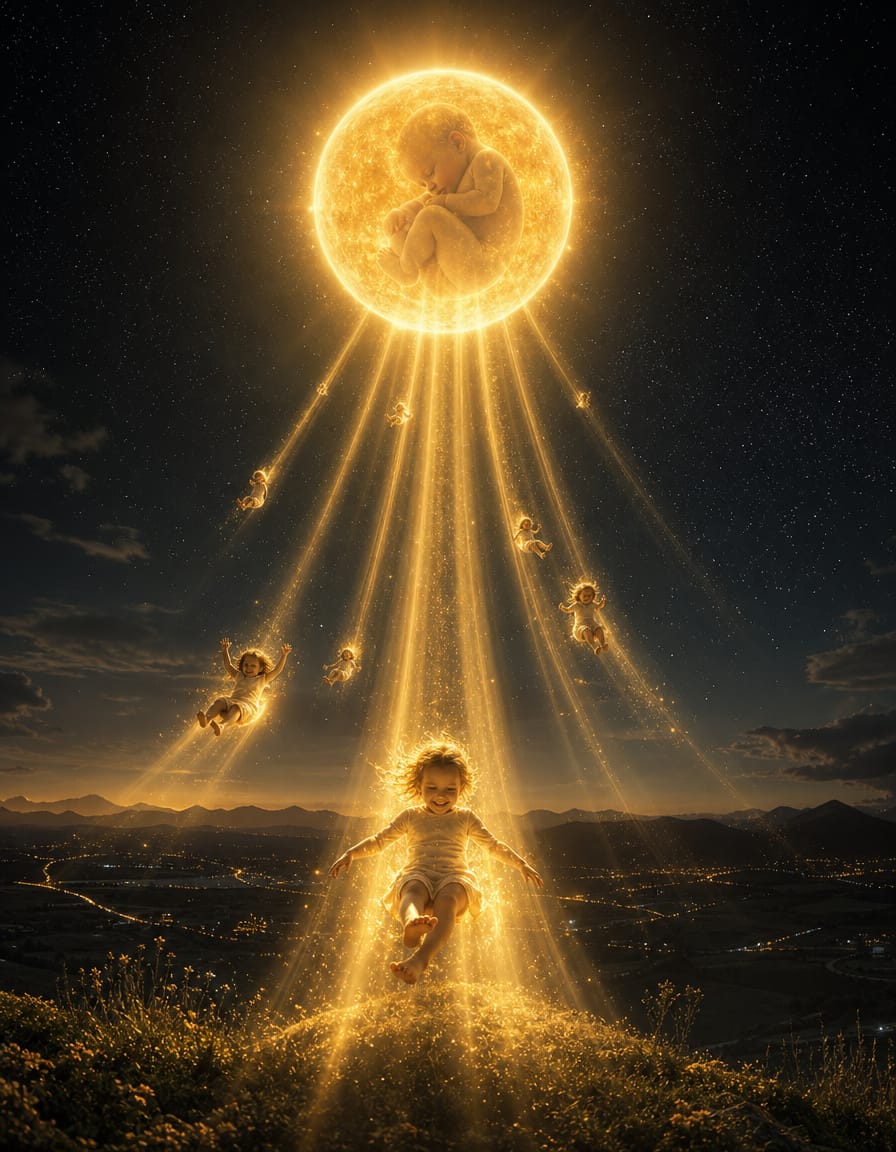
What she does not know, and cannot possibly know, is that on the night of his birth, the Mother Sun stood high in the heavens. Within her was a light-born child, and countless children of light slipped down her rays towards the earth. Once she had set these children down, she disappeared again. The Sun Children, however, scattered and travelled on to their appointed destinations.
No one noticed. Not even the astronomers.
A year has passed. Blind little Griannac is playing in the sitting room while his mother sits at her worktable, shaping a small figure from clay and quietly singing to herself.
Suddenly, the child looks up and stops playing.
A Sun Child has appeared and sits down beside Griannac. His mother cannot see it, but she senses that something has changed. She watches her son. Griannac turns towards the Sun Child, and the little being touches his forehead with one finger.
Then it happens. The Sun Child dissolves and disappears into the boy's forehead. Griannac remains completely still for quite some time. Then he crawls over to his mother and pulls himself upright against her knee.
“Mama,” he says.
His mother is overwhelmed. He has spoken his first word and stood for the first time - both at once! Something is different about her son. She cannot put it into words, but she can feel it. So she takes her child into her arms and gently rocks him, and the little boy nestles closely against her.
Mother and son remain like this for a long while.
From that day onwards, the child develops rapidly. Within a few days he is walking confidently and speaking his first sentences, and by the age of two he begins to ask questions. Somnia is fascinated and devotes herself wholeheartedly to the boy. She speaks to him as she would to an adult, answers all his questions, reads to him and sings songs to him. She tells him about his surroundings and about the city, and takes him into the countryside and into nature. She shows him plants and animals and explains that all life has evolved from the same original forms.
Griannac has a special relationship with animals. They come running to him. Even the creatures of the forest show none of their natural wariness, and he is allowed to touch them. But people love him, too. Every man and woman speaks to him, and even the children treat him with affection.
Day by day, his mother becomes more certain that he is a very special child, and she makes sure that he learns ever more about the world he cannot see. And it seems to her that he can see in another way - not with his eyes, but somehow else. She cannot explain it. From the very beginning, he never bumps into anything. He never trips over obstacles and seems able to sense things in his way, even in rooms he has never entered before.
When Griannac is five, he starts school - an ordinary school.
He is given special exercise books with lines that he can feel, and in this way he learns to write correctly, using his left hand. In the afternoons he attends a school for the blind, where he learns Braille and how to use a computer.
It happens for the first time at school.
One of his classmates brushes past him, and something suddenly feels wrong. Griannac turns to him.
“Are you ill?”
The boy looks at him in surprise.
“I've got a cold. How do you know?”
“I don't know…” Griannac replies.
When he tells his mother about it at home, she says, “Well, perhaps you heard it in his voice?” But Griannac knows perfectly well that it was not the boy's voice. It was a feeling.
Things like this happen again and again. And, as time goes by, it becomes more than a feeling. He begins to see the illness as a small grey creature sitting on people's shoulders. He tells his mother about it, and she advises him not to speak about it to anyone else.
“People are afraid of what is different from themselves,” Somnia tells him. “And fear can very quickly turn into dislike, and even hatred.” She wants to protect Griannac from that.
Griannac grows up and goes on to secondary school. He learns quickly and well and passes his final examinations with excellent results. There is one thing he knows for certain: He wants to become a doctor.
His mother asks whether this is possible for a blind person and receives nothing but negative answers. A doctor who cannot see his patients - how could he decide what was wrong with them? How could he treat wounds he could not see?
But Somnia refuses to give up.
In the house next door lives a general practitioner who has devoted himself to holistic medicine and also teaches at the university alongside his medical practice. He has an excellent reputation, both as a doctor and as a man of compassion. Somnia takes Griannac to see him. The doctor welcomes them kindly, but when he hears what Griannac wishes to do, his expression becomes serious. And then the mother says to her son:
“Tell the doctor what you see.”
Griannac tells him. The doctor listens thoughtfully. He is doubtful, and yet there is something about the boy's manner that gives him pause. Griannac sounds so certain, and not dreamy in the slightest. The doctor thinks. How could he test this? Then he turns to Somnia.
“I have to investigate this. You understand that, don't you?”
The mother nods.
“We'll do this. You bring the boy to my surgery tomorrow morning. He will sit quietly in a corner of the treatment room and only answer when I ask him a question. A curtain will hide him, as though he were a patient receiving an infusion. But when I ask him, he will tell me what he sees.
“Is that all right with you, Griannac?”
The boy nods, just as his mother did.
And so that is what they do. The boy sees the illnesses. He knows where they are located and points them out on the doctor's own body — and every single time, his answers are correct. The doctor is deeply impressed. He promises Somnia that he will help Griannac gain admission to medical school.
And he keeps his word. He secures Griannac a place at university, and his protégé is so successful that all the old prejudices begin to disappear.
Of course, there are difficulties. Laboratory work is challenging, and his hospital placement becomes a particularly difficult hurdle. But there is always a colleague of his mentor willing to give the young man a chance. And so Griannac successfully completes his studies and begins preparing for his doctorate.
The kind doctor takes him into his practice as a young colleague. He is soon rewarded for his generosity. Griannac's successes as a healer quickly become known, and all his patients come to love the young doctor.
His good deed has rewarded itself.
What more is there to tell? Griannac meets a young woman who has no difficulty with his blindness. Quite the opposite. She knows how to deal with it very well, especially because she comes to know him better and better - and, before long, to love him. And so the blind doctor finds himself a companion who supports him in every way, and the two of them become very happy together.
Their happiness reaches its highest point when they have a healthy baby girl, a beautiful little girl with incredibly radiant eyes. She is as pretty as her mother and as sensitive and captivating as her father. Her parents name her Grianneen. And within her lives the blessing of the Sun Child, just as it does within her father.
This is the happiness that Sun Children bring.
And if, one night, you happen to see bright sunshine in the darkness and hear the sound of children's laughter, then you will know:
More Sun Children have been released into the world.