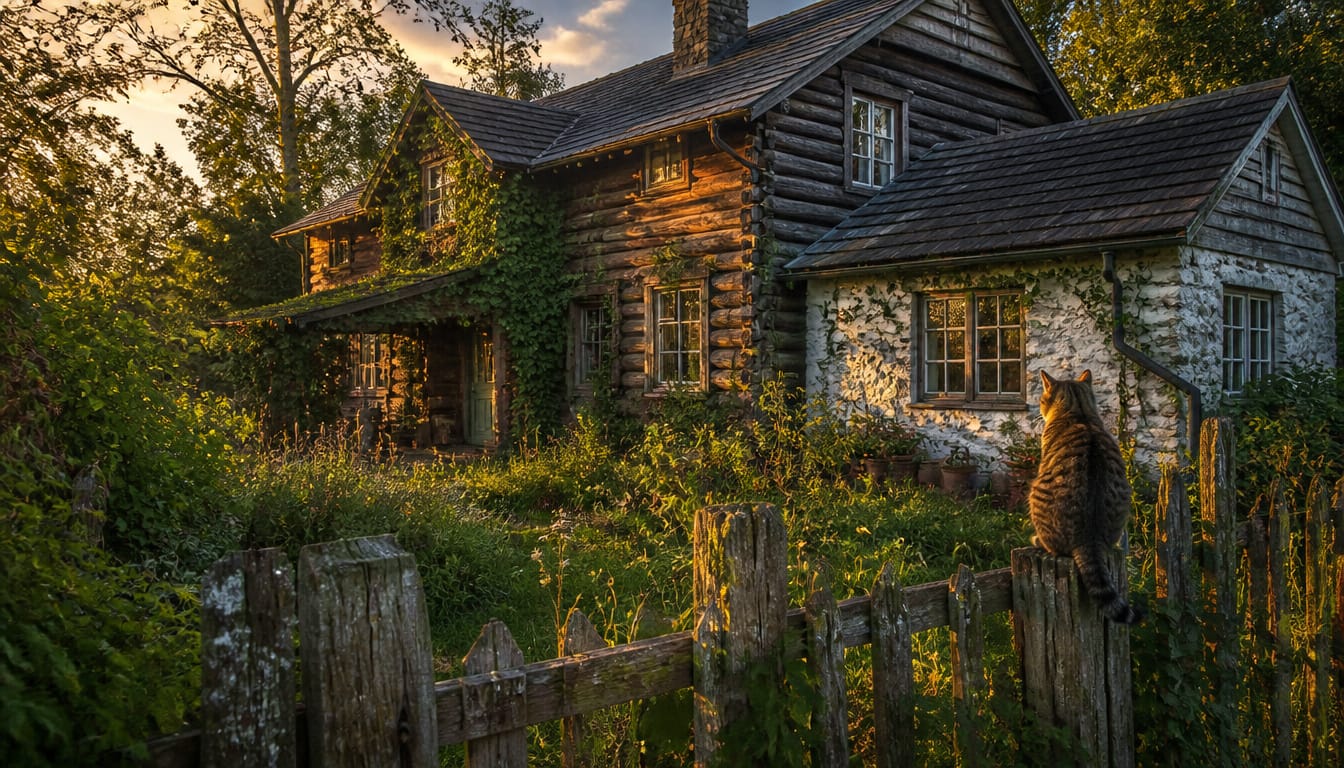
Once upon a time, a man built a house for himself and his family. He built it from sturdy timber logs, while the kitchen was constructed of stone, plastered with a mixture of clay and lime. The dark logs and the whitewashed masonry complemented one another beautifully, making it a charming little home. His wife and children loved their house and adorned it with everything that nature and the work of their own hands could provide.
Thus, generation after generation lived happily beneath its roof. Whenever the family grew, the house grew with them. An additional storey might be added or another room built on, yet it always remained faithful to its original style.
Naturally, difficult times came as well. From time to time misfortune befell the family who happened to be living there, yet the house had absorbed so much happiness over the years that even in those dark days it remained a warm and loving home. Every family that lived within its walls cherished it and cared for it with devotion.
It was an extraordinary house. People sensed as much, though none of them understood why. For over the centuries the house itself had come alive. It had absorbed so much of the human spirit—so much of the warmth and radiance of the souls that had dwelt within it—that, in time, it gained a soul of its own.
And so the house acquired a curious habit: it chose its own inhabitants.
Eventually, the elderly couple who had lived there until the end of their lives passed away, and their heirs scattered to every corner of the world. None of them wished to make the old house their home, and so it stood empty for quite some time. That was when the neighbours first realised there was something unusual about it. Unlike abandoned houses, it did not fall into decay. Dust settled on the furniture, the windowpanes became grimy, and a fine layer of dust covered the floors, yet the house itself remained as sound as though it had only just been built. Unable to explain this, the villagers declared it to be haunted. From that day on, none of the neighbours dared to enter it—not even the garden surrounding it.
The house, for its part, enjoyed the peace. Every now and then strangers arrived, hoping to settle in the district, and they would stop to look at the house. Yet every one of them left again without accomplishing anything. The house had simply not welcomed them.
The garden grew wild, and the house became increasingly overgrown. But then, one day...
One day, a young couple arrived in the district with their little daughter. They longed to leave the town behind and begin a quieter life in the countryside, for the child had never been particularly robust, and her parents hoped that the fresh country air would help restore her health.
Her father was an artist, a painter whose landscapes and portraits were admired by those who knew his work, though they brought him little wealth. Her mother was a musician. She played both the cello and the piano and earned a modest living by teaching music to children. Together they had just enough to live on, and although they possessed little, they had never stopped believing that a happy home mattered more than a grand one.
The moment they found themselves standing before the old house, they knew they had discovered something extraordinary. It was love at first sight.
Their little daughter ran straight to the front door. Before she could even reach for the handle, the door swung gently open, as though it had been expecting her all along. Her parents exchanged puzzled glances before cautiously stepping inside.
At once, a feeling of warmth and peace settled over them. It was impossible to explain. The rooms seemed to welcome them as naturally as sunlight welcomes the morning. Although dust lay everywhere and the windows had not been cleaned for years, the house felt alive, comforting and strangely familiar.
Meanwhile, their daughter wandered from room to room. Then she heard a soft whisper.
"Welcome, little one," said the house. "What is your name?"
Without the slightest surprise, she answered aloud, "My name is Elisabeth. What's yours?"
Her parents looked at one another in bewilderment. It seemed their daughter was talking to herself. But the house replied, and only Elisabeth could hear its gentle voice.
"I am waiting for you to give me a name. Until then, I shall simply be your house. Believe me—you will be happy here."
And so it proved.
The little family moved in with their few belongings, and before long the old house had become wonderfully cosy. The very first thing Elisabeth's father did was paint a picture of their new home. He captured the weathered house, the overgrown garden and, naturally, the family's cat, who insisted on appearing in the painting as though it had always belonged there. Both parents immediately set about restoring the neglected garden.
Little by little they cleared the paths, trimmed the shrubs and planted flowers wherever they could. Before long the garden was ablaze with colour. Bees hummed contentedly from blossom to blossom, butterflies danced in the sunshine, and among the flowerbeds and hedgerows there remained quiet corners where insects could nest and thrive undisturbed.
Elisabeth's mother was offered a position as the music teacher at the village school, while her father became curator of the small local museum. The work suited him perfectly, leaving him ample time for his painting. Their income was modest, but it was enough. More importantly, they had found the place where they truly belonged.
The neighbours, however, were not so easily persuaded. They refused to change their opinion of the old house. Again and again they warned the family that there was something uncanny about it and that no good could come of living there. When Elisabeth and her parents paid no attention and seemed happier with every passing week, the villagers began to regard them as rather peculiar themselves. In time they simply left the family to themselves.
Their children, however, listened carefully to the conversations at home. And children, as children sometimes do, repeated what they heard without understanding it. Neither the house nor Elisabeth was left in peace. More than one stone found its way into the garden. One day a window was even smashed. At school, Elisabeth was pushed about in the playground. The other children stole her sandwiches and snapped her pencils simply because she was different.
The little girl became desperately unhappy. Whenever she came home in tears, she would tell the house everything. The house listened patiently. And one day, it offered her a piece of advice. The house had listened carefully.
At last it said, "Why don't you ask your parents to hold a birthday party for you this year?"
"A birthday party?" Elisabeth asked in surprise.
"Yes," the house replied. "Invite every child in your class."
She frowned.
"But none of them likes me."
"They simply do not know you yet," said the house gently. "Give them the chance."
Elisabeth thought about those words for a long time. That evening she spoke to her parents.
"My birthday is coming soon," she began hesitantly. "May I invite everyone from my class?" Her mother looked doubtful.
"Everyone?"
"Even the children who have been so unkind to you?" asked her father. Elisabeth nodded.
"I'd like them all to come."
Her parents exchanged uncertain glances. They loved their daughter dearly, yet they feared she might only be hurt again. Still, they saw how much the party meant to her, and in the end they agreed. When Elisabeth invited her classmates at school, she did so in the presence of her teacher. No one wished to refuse her outright. Besides, every child in the village had heard stories about the strange old house. Curiosity soon overcame hesitation. One by one they persuaded their parents to let them go.
At last the long-awaited day arrived.
When Elisabeth's parents awoke that morning, they could scarcely believe their eyes. The house had been transformed. Without anyone lifting a finger, every room was beautifully decorated for a children's celebration. Bright ribbons and colourful garlands adorned the walls. Fresh flowers stood in cheerful little bunches upon the tables, and the whole house seemed filled with light. Outside, the garden looked as though it had dressed itself for the occasion. The tables were laid with cakes, pastries, biscuits and every sort of sweet treat a child could dream of. There were games waiting to be played, little surprises to be discovered and laughter seemed almost to linger in the air before the first guest had even arrived.
Neither Elisabeth nor her parents could explain any of it. The house remained pleasantly silent.
Soon the children began to arrive.
At first they stepped through the gate rather cautiously. They had expected something gloomy. Something frightening. Instead, they found warmth, colour and welcome. Before long they had forgotten every frightening tale they had ever heard. They played games all afternoon. They laughed until their sides ached. They feasted on cakes and sweets, chased one another through the garden and invented adventures among the flowerbeds. For many of them it became the happiest day they had ever spent.
As evening fell and their parents came to fetch them, the children could scarcely stop talking. Their mothers and fathers listened in amazement. Could this really be the same haunted house everyone had feared for so many years? Perhaps...
Perhaps they had all been mistaken. No one admitted it aloud. But from that day onwards the villagers began, little by little, to look less suspiciously at the family who lived in the old house. That birthday party changed far more than anyone could have imagined. For the first time since the family had arrived, Elisabeth had real friends. Children who had once mocked her now knocked at the garden gate simply to ask whether she might come out to play.
The old stories about the haunted house slowly began to fade, replaced by new ones. People still thought the house rather unusual, but no longer frightening. They would pause outside its gate, admire the flowers or exchange a few friendly words with Elisabeth's parents. Little by little, the old fear gave way to quiet affection.
One evening, when the garden lay bathed in the golden light of the setting sun, Elisabeth sat upon the front steps with her parents. She had been unusually thoughtful. At last she looked up.
"There is something I ought to tell you." Her parents smiled.
"What is it?" - "The house talks to me."
Neither of them laughed. Instead, they listened.
"It has always spoken to me," Elisabeth continued. "Not with words that everyone can hear. Only I can hear them." She hesitated for a moment.
"It was the house that asked me to invite everyone to my birthday."
Her parents exchanged a glance.
"The decorations... the cakes... the games... all of it..." She looked back at the old house.
"It did everything because it wanted me to be happy."
For a long while no one spoke. The evening breeze stirred gently among the flowers, and somewhere in the garden a blackbird began to sing. At last Elisabeth's father smiled.
"You know," he said quietly, "artists are often told that they believe impossible things." Her mother laughed softly.
"And musicians are told much the same." She reached for Elisabeth's hand.
"So perhaps we are exactly the right family to believe you."
At that very moment the house seemed to sigh - a deep, contented sigh that sounded almost like old timber settling peacefully after a warm summer's day. Then the gentle whisper returned.
"I have been waiting." Elisabeth smiled.
"I know."
"You promised me something."
"I did."
"You were going to give me a name." The little girl looked slowly around her. At the weathered beams. At the white walls.At the flowers beneath the windows. At the home that had chosen them long before they had chosen it.
Then she said quietly, almost as though the name had always been there, waiting to be spoken,
"I shall call you Hoamatl."
The house remained silent. Yet every beam, every stone and every flower seemed to glow with quiet happiness. It had finally received the one gift it had waited centuries to receive. A name. Its own.
From that day onward, whenever anyone asked where the family lived, Elisabeth would answer with a smile,
"We live in Hoamatl."
And somehow, everyone who heard her say it felt that no other name could ever have suited the old house half so well.
Years passed. The garden grew ever more beautiful. Paintings filled the walls. Music drifted through the open windows. Children's laughter echoed beneath the old trees. The house gathered every joyful sound, every loving word and every happy memory into its quiet heart, just as it had done for generations before.
As for Elisabeth...
The country air certainly helped her. But those who knew the whole story would always smile and say that fresh air alone had never healed a child. Love had.
And Hoamatl had been full of it.